Written August 2026. Menus move, so if a button isn't exactly where I say it is, look nearby. The idea doesn't change.
Your inbox is the most complete record of your business that exists anywhere. Every price you quoted. Every scope change you agreed to on a Thursday afternoon. Every proposal nobody ever answered. It's all sitting in there, and none of it is findable in a way that helps, because search wants a keyword and you want an answer.
Connecting Claude to your email fixes the asking part. You stop hunting for the right search term and start asking the question you actually have.
Six things I use it for every week, and the exact words I type. Save this for when you're at your laptop, because the setup is a laptop job and everything after it works from your phone.
Start here. You have to connect it first
Claude can't see any of your email until you do this. It's the only setup part on this page, and then you never think about it again.
The exact path:
- Go to claude.ai on a laptop.
- Click your initials in the bottom left, then Settings, then Connectors. There's a second route if you'd rather: click the plus sign in the message box and hover over Connectors.
- Find Gmail and click Connect.
- Google takes over from there and asks what you're giving it access to. Read that screen instead of clicking through it, then approve.
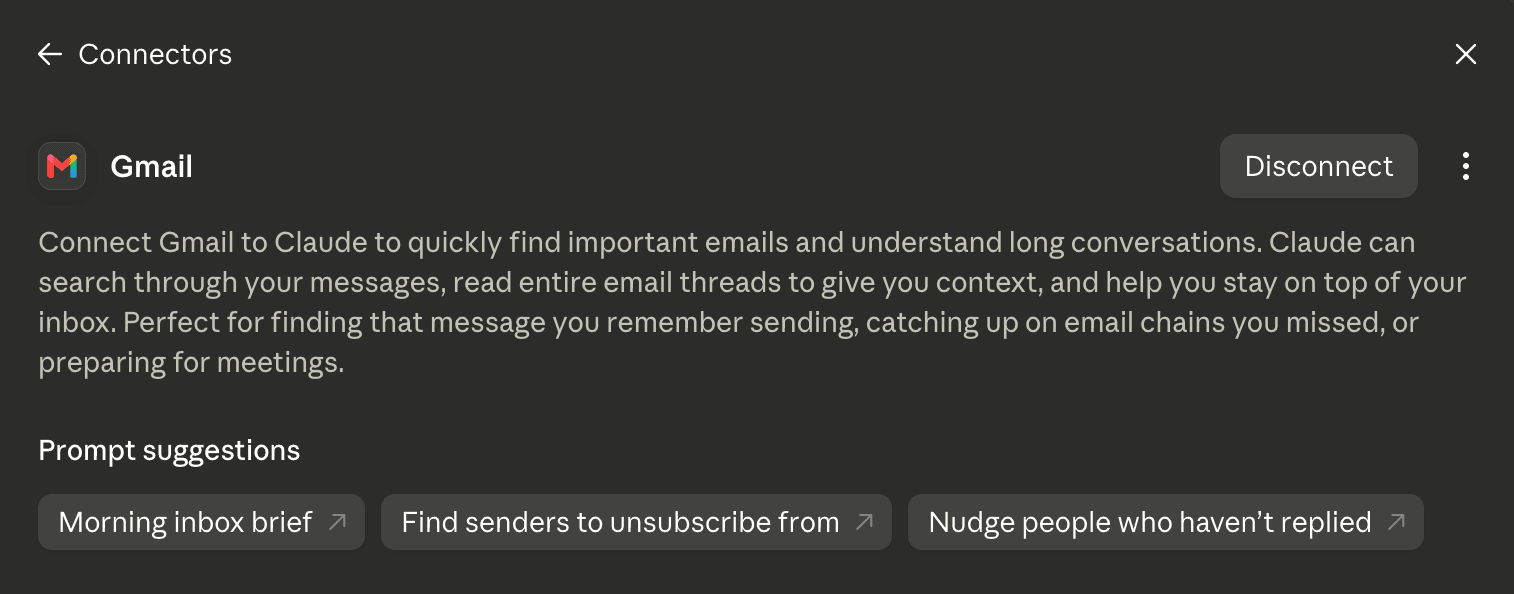
What plan you need: the Google Workspace connectors work on every plan on Claude and Claude Desktop. One catch if you're on Team or Enterprise: an Owner has to switch the connector on for the whole organization before you can connect your own account. If Gmail isn't in your list at all, that's who to go ask.
While you're in there, Google Calendar and Google Drive are sitting right next to it. Calendar is worth connecting at the same time, because half the questions below get better answers when it can see what you actually had scheduled.
Two minutes, once.
How to tell it's really reading your email
The first time you ask it something, you'll wonder whether it looked or whether it made a good guess. Two ways to check.
It asks permission on screen before it touches your mailbox, so you'll see it happen. Then the answer comes back with the emails it used listed underneath it. Those are links.
Click one. Do that once and you'll stop wondering.
1. The 22-message thread
You know the one. The client where the scope moved three times and now you're not sure what you promised, so you keep putting off the reply because reading it back is a 20 minute job you don't have 20 minutes for.
Read my whole thread with [name]. What did I agree to
and what still needs a reply?
It just tells you. Takes about 30 seconds, and it reads all 22 messages in order instead of skimming the last three the way you would.
The mistake that makes it fail: asking for a summary. A summary hands you back the same thread, shorter, and you still have to work out what it means for you. Asking what you agreed to and what's outstanding gives you two lists you can act on. Name the person, not the topic, because it's searching a mailbox, not reading your mind.
2. The email you keep not sending
The price increase one. You've rewritten it four times and it's still sitting in drafts, because every version sounds either apologetic or like a lawyer wrote it.
Read the last 10 emails I sent so you know how I sound.
Now draft a reply to [name].
The first sentence is the whole trick. Skip it and you get the brochure voice that made you rewrite it four times in the first place. Tell it how you talk one time, and it writes them how you talk.
The mistake that makes it fail: pointing it at emails that don't sound like you. If your last 10 sent messages are all one-line replies to your accountant, it's learning from one-line replies to your accountant. Point it at 10 you'd be happy to have written, and say so.
3. Where is that contract?
The signed one. The invoice number. What you quoted this client 8 months ago, before you raised your rates, which you need before you can answer the email sitting in front of you.
Find what I quoted [name] and when I sent it.Ask it the way you'd ask a person. You don't need the search operators and you don't need to remember the subject line.
The mistake that makes it fail: the number being inside an attachment. Claude reads your emails and it can see that an attachment exists, but it can't open a PDF that came in on a Gmail thread and read the figure out of it. If your quotes go out as attachments, it'll find you the right email on the right date and then you open the file yourself. Still faster than hunting. Just know that's where it stops.
4. What am I forgetting?
Proposals nobody answered. The person you swore you'd get back to on Tuesday. That yes you gave in a thread you've since buried under 400 newsletters.
Go through the last 30 days. What's waiting on me?
Who did I say I'd get back to?
Ask it on a Monday and it just tells you. This is the one that changed my week the most, and it's the one that sounds the least impressive written down.
The mistake that makes it fail: a giant mailbox. Performance gets worse the more it has to wade through, so 30 days works and "go through everything" gets vague and slow. Keep the window tight and run it more often.
5. There's money in your sent folder
Quotes nobody ever replied to. Invoices nobody paid. Most of it didn't get turned down. It expired, because nobody followed up, and the nobody was you and you were busy.
Look at everything I sent in the last 90 days. Which
quotes and invoices never got a reply?
Run it once and you'll see why this is the one I'd start with. It's the only item on this page that pays for itself the same afternoon.
The mistake that makes it fail: stopping at the list. The list isn't the point, the follow-ups are. Hand the list straight back to it and say draft me a short follow-up for each of these, then use number 2 above so they sound like you.
6. The meeting that never got a follow-up
This one needs Calendar connected too. That's why I told you to grab it back in the setup. Your calendar knows who you talked to. Your inbox knows who you wrote to afterward. Neither one knows about the other. That gap is where good calls go to die.
Compare my calendar and my sent email for the last
two weeks. Which meetings never got a follow-up
from me?
Every call you were excited about on a Tuesday and forgot by Thursday shows up on that list. Same idea as number 5. It's just pointed at conversations instead of quotes.
The mistake that makes it fail: expecting it to know what counts as a follow-up. A recurring team sync doesn't need one. Tell it which meetings you care about. Something like only the calls with people outside my company. Then the list is short enough to act on.
It can sort while it's in there
Reading isn't all it does. It can label a thread. It can make you a new label too, as long as you approve it first. That turns any of the lists above into something you can still find next week.
Label those threads "Follow up" so I can find them
in Gmail later.
Run this right after number 5 and the follow-ups you didn't get to are waiting in a folder instead of sinking back into the pile.
The part everyone asks about first
It can't send email. Not "you should be careful," not "make sure you review it first." The send function isn't switched on at all. Claude reads your email and writes drafts, and every single one of them sits in your drafts folder until you open it and hit send yourself.
I still read every one before it goes. But people hesitate because they're picturing some AI firing off messages to their clients while they're at school pickup. That can't happen.
Two more worth knowing. It asks before it does anything, so nothing happens in your mailbox that you didn't approve on screen. And if you're on Team or Enterprise, an Owner can lock the connector down even further. It can search and read while anything that writes stays blocked.
When it doesn't work
Four things go wrong. All four take about a minute to fix.
Gmail isn't in your connector list. If you're on Team or Enterprise, an Owner has to turn it on for everyone first. If your email runs on Google Workspace through your business, there's a second gate. Your Workspace admin has to mark Claude as a trusted app. The path they need is admin.google.com, then Security, then Access and data control, then API controls, then Manage third-party app access. Send them that line. If your email is a plain gmail.com address, none of this applies to you. Just connect it.
It acts like your inbox is empty. Usually it's hooked to the wrong Google account. Go back to Connectors and hit Disconnect. Then ask it an email question again and it'll walk you through signing in fresh. This fixes more than you'd think.
The answers come back vague. You gave it too much ground to cover. Searching your whole mailbox gets slow and fuzzy. 30 days with a name in it gets sharp. Narrow the window before you assume it can't do the job.
Your usual Gmail search tricks don't land. Some of the advanced filters don't carry over. Ask in plain words instead of operators, the way you'd ask an assistant. Let it work out the search.
The fastest path to a win
1. Connect Gmail. Two minutes, on a laptop, and nothing below works without it.
2. Run number 5 first. The sent folder one. Do it before you do anything else on this page.
3. Take the worst thread you own and run number 1 on it.
4. Point it at your last 10 sent emails once, so it learns how you sound.
5. Put number 4 on a Monday. Every Monday.
None of this needs you to be techy. You connect it one time and then it does the boring part for you.
If you only do one thing: the sent folder. 90 days back. I've never once run it and found nothing.
Every prompt on this page, in one place
Copy these somewhere you'll find them. Swap the brackets for a real name.
Read my whole thread with [name]. What did I agree to and what still needs a reply?Read the last 10 emails I sent so you know how I sound. Now draft a reply to [name].Find what I quoted [name] and when I sent it.Go through the last 30 days. What's waiting on me? Who did I say I'd get back to?Look at everything I sent in the last 90 days. Which quotes and invoices never got a reply?Compare my calendar and my sent email for the last two weeks. Which meetings never got a follow-up from me?Label those threads "Follow up" so I can find them in Gmail later.